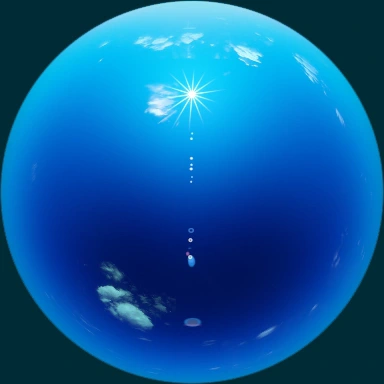
Rex
Rex is ready for public testing. We're beginning to invite members of our mailing list today.
Rex is a drop-in replacement for whichever terminal you use today and you will feel an instant upgrade in user experience, quality, and capabilities such as persistent sessions, performant and responsive remote connections, program activity status, and more. Plus, it's simply beautiful.
I'm extremely excited that Mitchell and the team at Superlogical are finally getting ready to release their terminal multiplexer. When I first heard Mitchell talking about replacing tmux and Zellij, it sounded like a pipe dream. But less than two years later, public testing is starting with the macOS app, with clients coming to iOS, Windows, and Linux along with headless servers on Linux and Windows, all while being completely free to self host with no accounts required.
I started using Zellij early this year and then switched to Herdr to keep agent sessions running even when I closed my laptop. With Tailscale and Moshi, I can open web apps and prompt any agent session running on any of my machines, all from my phone. There is also incredible multiplayer support (Rex will have this too!), which allows me to collaborate on any terminal or agent session with my brother in Austin, with perfectly synced typed characters at virtually no latency. This was a revelation for me. Prior to switching to a Mac early this year, I had done all my development on my large desktop gaming computer (which is now running Linux!). It took forever to boot, VSCode felt sluggish, and the whole setup was clunky. I had to start and close servers manually through an SSH terminal in WSL while managing everything else on my computer. Nowadays, I can open my laptop, have everything wake instantly from sleep, type herdr, and connect to all my machines through one panel. I can even develop iOS apps from my MacBook with 16 GB of RAM without breaking a sweat.
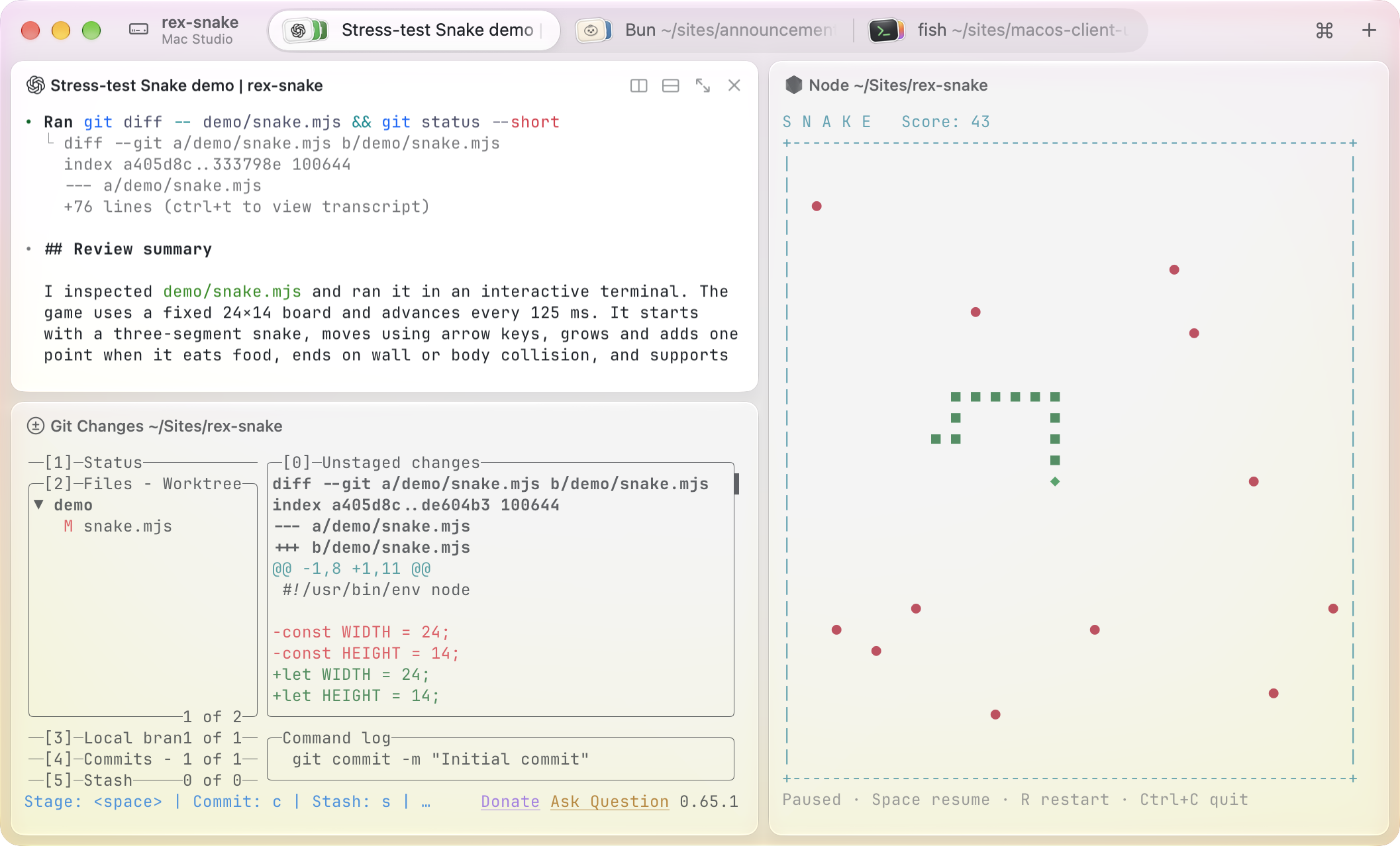
But back to Rex, the screenshots and demos Mitchell posted on his YouTube channel look absolutely incredible. I love the double Liquid Glass border around the panes. It reminds me of the rounded, floating Liquid Glass sidebars in macOS Tahoe that Apple removed in macOS 27. I couldn't think of a better way to divide terminal panes. The little animation of the app icons fanning out in the tab bar when there are multiple panes is also an incredible touch. This all in one terminal app is easily the best looking I have ever seen. Even the logo and mascot, Rexie, have the same amazing charm as Ghostty. Apps like Termius, Warp, and cmux have tried to look this good, but to me their overly complicated buttons, bloated settings, and clunky interfaces get in the way. I'm also really excited about the light mode and automatic contrast correction. I've been trying to switch Ghostty between light and dark mode with the time of day, but light mode just hurt my eyes no matter which theme I used.
Perhaps Rex can sway the majority crowd that prefers regular interfaces over terminal interfaces. I was once one of those people. I always felt the terminal was some archaic remnant of the early days of computing that had somehow survived this long because loud, nerdy, stubborn Linux users had gotten too comfortable with their tools. But using Ghostty and Starship, along with beautifully designed terminal apps like OpenCode, changed my mind. Sure, there are some commands to remember (cd, ls, mkdir), and you have to learn your way around the file system. But that little bit of understanding truly pays dividends. In my computer architecture and operating systems classes at UofT, I found it incredibly confusing to switch between VSCode and its slow integrated terminal. Editors like this can make the terminal, the real interface to the computer, feel like something extra. Yeah, many get by without ever installing a dedicated terminal app, but for me, having that layer tucked away made it harder to understand what was happening underneath. On top of that, getting too integrated into a provider's desktop app can lock you into its AI suite. Things like Dots, Claude Design, and Snapshots are goodies that give people reasons to stay in those ecosystems. In a terminal, opening another agent is as easy as opening a new tab and typing its name. Maybe providers eventually reduce or stop supporting their CLIs, but I imagine they'd have to offer something pretty close to AGI to do that without pushback.
Then there are applications like T3 Code that offer feature rich graphical interfaces. I've actually been enjoying T3 Code this past week. It definitely has its advantages: a native and MUCH more friendly mobile UI, switching providers mid conversation, integrated iOS simulators, picture in picture mode, a browser that works across agents, and the ability to see attached images. My concern with an app like this is keeping up with every provider's slash commands and features. These CLIs, like everything else in the industry right now, are incredibly fast moving targets. If a provider changes or stops supporting the SDK an app depends on, you would likely have to go back to your terminal multiplexer while Theo and the team work out a fix. There's a reason ACP never got native support from OpenAI or Anthropic. Maybe the same agents making these tools hard to keep up with will also make them easier to maintain. An application as complex as T3 Code would have been a nightmare to maintain just ten months ago.
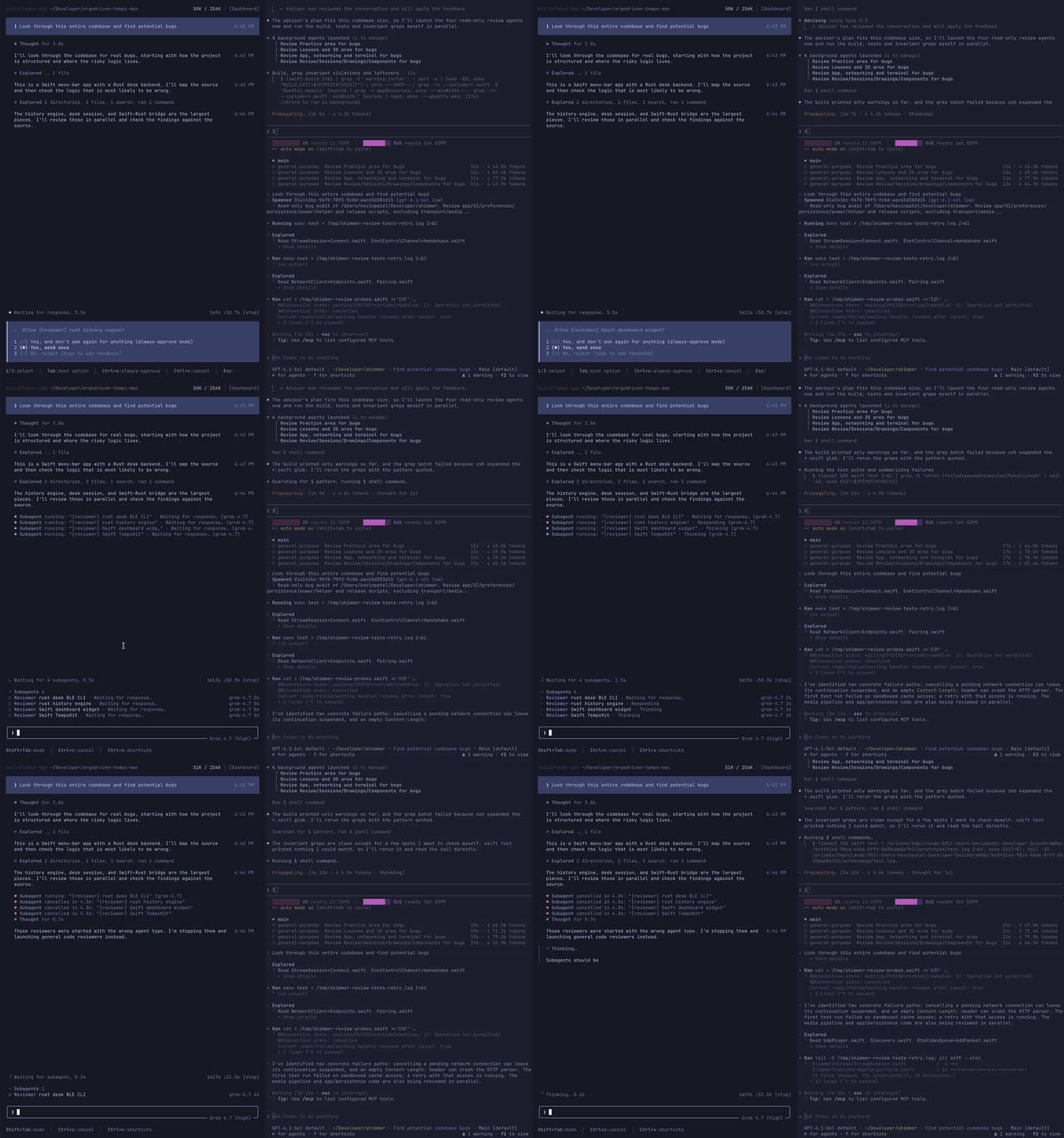
One thing I definitely miss when using T3 Code is seeing the agents' own terminal UIs. I know there's some controversy around these interfaces feeling like colourful slot machines, intentionally made addictive as a growth hack. But I think that takes it all a bit too seriously. Programming should be fun. These terminal interfaces each have their own charm, and there's something almost timeless about them. It's the same feeling I get from Minecraft or Street Fighter sprites. And maybe I just have a case of AI psychosis, but I find a lot of beauty in the sight of multiple agents churning away at once. It reminds me of those Matrix screensavers. There's something therapeutic about watching all those thought processes scroll by in neat monospace text and carefully chosen colours.
Anyways, I'm really excited for this release. Mitchell is a very talented developer, having built Terraform, and is using his wealth to give back and build high quality products that benefit everyone. We're already seeing his program status protocol being adopted by Claude Code, Pi, OpenCode, Grok, Herdr, and others in less than a week. I can't wait to use native scrolling and tabs in remote sessions and experience those lightning fast connections with no typing latency. Other things are stirring as well. DHH, the creator of Ruby on Rails, is replacing HEY's tech stack with native frontends across all platforms and a Rust backend. I think we're starting to see some of the fruits of the agentic era: software that is faster, more featureful, more intuitive, and much better looking.